From manual to fully-electric ICU beds — we connect you with a patient in your pincode who's already rented one, across 18 cities.

A hospital bed is a specially designed bed used for patients who are bedridden, recovering from surgery, or need ongoing medical care at home. Unlike a regular bed, it's adjustable in height, backrest, and leg position — reducing the need for caregivers to bend over, and lowering fall risk with side rails and a bed that can be brought closer to floor level.
The core structural difference comes down to three things a regular bed simply doesn't offer: independent adjustment of the head and knee sections, a height range that goes low enough for safe transfers and high enough for a caregiver to work without bending, and a frame built to support repeated adjustment without wearing out. A typical home mattress and bed frame aren't engineered for this — they're built for static comfort, not for changing position multiple times a day, every day, for weeks or months.
The right bed depends entirely on the patient's condition — a stroke patient, a post-surgical knee-replacement patient, and a terminally ill patient each benefit from different adjustability and features, which is exactly why hospital beds come in so many configurations rather than one standard type. A family managing a short recovery after a fracture has very different needs from a family managing long-term bedridden care for a parent with advanced Parkinson's, and matching the bed to the actual situation — rather than just picking whatever's cheapest or most advertised — genuinely affects both comfort and safety.
A hospital bed isn't only for the terminally ill or critically injured — it's genuinely useful across a much wider range of everyday recovery situations than most families realise before they actually need one.
From a basic manual bed to a fully-electric 5-function ICU bed — here's what each type actually offers, who it typically suits, and what past patients have paid.

Hand-crank operated, allows head and leg elevation.
Suitable for basic medical needs, elderly care, and short-term recovery where a caregiver is available to adjust the bed a few times a day. The most budget-friendly option, and often the right choice when adjustments are infrequent.

Head elevation only — helps patients sit up comfortably for eating or resting, and reduces reflux or breathing difficulty when lying fully flat.
Simple hand-crank operation, good for basic elderly care where only upper-body positioning matters.

Adjusts both head and leg position via hand crank.
A step up from semi-fowler for patients needing more positioning flexibility — particularly useful for reducing swelling in the legs by elevating them independently of the backrest.
Often sits on top of an existing home bed — no extra floor space needed, which matters in smaller Indian apartments.
Elevates upper body and knees for comfortable, supported rest, and is remote-operated for easy one-handed adjustment.

Remote-controlled height, backrest, and leg adjustment.
Suited to home ICU setups and patients needing frequent repositioning — the electric motor means a caregiver can adjust the bed without physical effort, which matters over weeks of daily use.
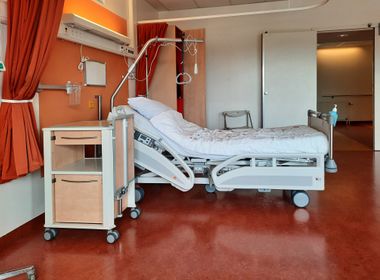
Adds Trendelenburg and reverse-Trendelenburg tilt to height/backrest/leg control — used for more critical or complex care needs where specific body positioning affects circulation, breathing, or a particular medical procedure at the bedside.
These are estimates from what other patients have shared, not prices we charge or set — actual cost depends on the provider, brand, and rental duration.
Often rented alongside a hospital bed, based on what past patients have shared.
| Equipment | Typical Monthly Rent |
|---|---|
| Manual Wheelchair | ~₹1,000 – ₹1,500 |
| Wheelchair with Commode | ~₹1,500 – ₹2,000 |
| Electric Wheelchair | ~₹6,000 – ₹8,000 |
| Oxygen Concentrator (5L) | ~₹4,000 – ₹5,000 |
| Oxygen Concentrator (10L) | ~₹6,000 – ₹8,000 |
| BiPAP Machine | ~₹5,000 – ₹6,000 |
| CPAP Machine | ~₹4,500 – ₹5,500 |
| Air Mattress (Bedsore Prevention) | ~₹3,500 – ₹4,500 |
| Suction Machine | ~₹2,000 – ₹3,500 |
| IV Stand | ~₹500 – ₹800 |
Estimates from past referrals — your actual cost depends on the specific provider and equipment brand.
Manual vs electric operation is the single biggest price driver — electric beds typically cost close to double their manual equivalents, since they include a motor, remote unit, and internal wiring that manual cranks don't need. The number of adjustable functions (2, 3, or 5) adds cost incrementally, since each additional motor and mechanical linkage adds to both manufacturing cost and maintenance complexity. Brand also plays a role — beds from established manufacturers with a longer service history and readily available spare parts often rent for a modest premium over generic alternatives, which can be worth it for a longer rental period where reliability matters more.
Rental duration affects the effective daily cost significantly — providers typically offer better per-day rates for 30, 60, or 90-day commitments compared to a 7-day rental, since their own logistics (delivery, pickup, cleaning) cost roughly the same regardless of how long you keep the equipment. If you expect to need the bed for more than a month, asking about longer-commitment pricing upfront is worth the conversation.
As a rough guide: renting is almost always cheaper for anything under 4–6 months of use. Beyond that, the math gets genuinely close. Take a 3-function electric bed as an example — renting at ~₹6,000/month costs ₹72,000 over a year, while buying the same bed outright typically runs ₹60,000–₹68,000. At the one-year mark, buying starts to look more economical, assuming you're confident the need will continue and you're willing to handle maintenance yourself once the rental provider's support period ends.
For shorter, genuinely uncertain timelines — which describes most post-surgical recovery situations — renting remains the more sensible default, since the flexibility to return the bed the moment it's no longer needed outweighs any marginal savings from buying that you might not actually realise.
No provider directory to browse, no guessing between unfamiliar rental companies — just a pincode, a short wait, and a referral from someone who's already been through the exact same search.

Tell us the bed type needed and your pincode.

Someone who's already rented a similar bed nearby.

Which provider they used, exact cost, and delivery experience.

Contact them directly — we're not involved in booking or delivery.
"When my father was discharged after his stroke, we suddenly needed a hospital bed within two days. A colleague had rented a 3-function electric bed for her own parent recently and gave me the provider's number. Delivery and setup happened the same evening — having a real recommendation with an actual price saved us from guessing between a dozen unfamiliar rental companies online."
Renting a hospital bed is one of the most common medical equipment needs for Indian families managing post-surgical recovery, stroke rehabilitation, paralysis care, or elderly support at home. Choosing the wrong bed type, or missing an important feature, genuinely affects both the patient's comfort and the caregiver's daily workload — this guide covers everything worth knowing before you rent, from the mechanical differences between bed types to the practical details of setup, hygiene, and eventual return.
Manual beds use hand cranks to adjust height and positioning. Each crank connects to a mechanical linkage inside the bed frame that raises or lowers a specific section — turning the crank at the foot of the bed, for instance, typically raises or lowers the backrest. This is the most affordable option, but every adjustment requires a caregiver to physically turn the crank, which can mean several minutes of manual effort each time the patient's position needs to change, several times a day, day after day.
Semi-electric beds use electric motors for the head and foot adjustments while height remains manually cranked — a genuine middle ground that removes the most frequently needed adjustments (sitting a patient up, lowering their legs) from manual effort, while keeping the less-frequently-changed height adjustment manual to save cost.
Fully-electric beds offer complete remote-controlled adjustment of height, backrest, and leg position, and the higher-end models add Trendelenburg (head-down tilt) and reverse-Trendelenburg (feet-down tilt) functions. For a caregiver managing a bedridden patient over weeks or months, the cumulative time and physical strain saved by electric operation is substantial — this is often the deciding factor between manual and electric for longer-term care, more than the price difference itself.
A 1-function bed typically adjusts only the backrest. A 2-function bed adds independent leg/knee elevation. A 3-function bed adds height adjustment on top of backrest and leg control — this is the configuration most home-care situations actually need, since it covers positioning for comfort, feeding, breathing, and safe caregiver access. A 5-function bed adds Trendelenburg and reverse-Trendelenburg tilt, which are specifically used to improve venous return and circulation, assist certain respiratory positions, or support specific medical procedures performed at the bedside — genuinely useful for ICU-level care, but unnecessary for most standard post-surgical or elderly-care situations.

Trendelenburg position tilts the entire bed so the head is lower than the feet — historically used to improve blood flow to the brain and core organs in certain medical situations, though its use has narrowed over time as medical understanding has evolved, and it's now applied more selectively under specific clinical guidance. Reverse-Trendelenburg does the opposite — feet lower than head — which can ease breathing for patients with certain respiratory conditions and reduce the risk of aspiration during feeding for bedridden patients. Neither position should be used without specific medical guidance for your patient's condition; this is a feature worth having available for a doctor or trained nurse to use when appropriate, not something a family member should experiment with independently.
Standard foam mattresses, included with most basic rentals, work fine for patients who can reposition themselves or are repositioned regularly by a caregiver. Alternating-pressure mattresses use an internal pump to continuously shift pressure points, specifically designed to prevent bedsores in patients who spend most of the day in one position. Low air-loss mattresses combine pressure redistribution with airflow to manage moisture, useful for patients at higher risk of skin breakdown. If your patient is fully bedridden and unable to reposition independently, asking specifically about upgrading to a pressure-relief mattress is worth the modest additional cost — bedsores are far more painful and difficult to treat than they are to prevent.
Side rails that fold down completely (rather than being fixed or only partially removable) make transferring a patient significantly easier without needing to remove the entire rail assembly. Low-height settings — some beds go as low as 14 inches from the floor — reduce injury risk if a patient rolls or attempts to get up unassisted, and make transfers from a wheelchair genuinely safer. An emergency CPR release function, standard on higher-end electric beds, allows the backrest to be rapidly flattened in a medical emergency without needing to run the motor through its normal cycle — a feature worth asking about specifically if you're renting for a patient with any cardiac risk.
Individual wheel brakes (rather than a single master brake) let a caregiver lock specific wheels while still allowing controlled repositioning of the bed within a room — genuinely useful in smaller Indian bedrooms where the bed sometimes needs to shift slightly to access a wall outlet or clear space for equipment. Stainless steel or mild-steel collapsible side rails provide grip support for a patient trying to reposition themselves in bed, in addition to their fall-prevention role. An ABS plastic headboard and footboard that's removable or interchangeable adds convenience during medical procedures or when moving the bed through a narrow doorway during setup.

Standard hospital beds typically support up to 120–150 kg, which covers the vast majority of patients — but if the patient's weight approaches or exceeds this range, a bariatric-rated bed with a reinforced frame and wider mattress becomes a genuine safety requirement, not an optional upgrade. Always confirm the actual weight rating with the provider rather than assuming a standard bed will work, since exceeding the rated capacity risks frame failure and genuine injury.
Manual vs electric operation is the single biggest price driver — electric beds typically cost close to double their manual equivalents, since they include a motor, remote unit, and internal wiring that manual cranks don't need. The number of adjustable functions adds cost incrementally, since each additional motor and mechanical linkage adds both manufacturing and maintenance complexity. Brand also plays a role — beds from established manufacturers with a longer service history and readily available spare parts often rent for a modest premium over generic alternatives, which can be worth it for a longer rental period where reliability matters more than saving a few hundred rupees a month.
Rental duration affects the effective daily cost significantly — providers typically offer better per-day rates for 30, 60, or 90-day commitments compared to a 7-day rental, since their own logistics (delivery, pickup, cleaning) cost roughly the same regardless of how long you keep the equipment. If you expect to need the bed for more than a month, asking about longer-commitment pricing upfront is worth the conversation, and some providers offer meaningful discounts for 90-day-plus rentals that aren't advertised unless you ask directly.
Most providers include delivery and setup in the rental price — but confirm this specifically, since some charge separately for delivery beyond a certain distance, or for setup assistance versus simply dropping off the equipment. Ask about their maintenance and replacement policy if the bed malfunctions during your rental period — a reliable provider should offer prompt repair or replacement, not leave you without functioning equipment for days while you wait for a technician. Confirm whether a refundable security deposit is required and its exact amount, and clarify the process and timeline for getting that deposit back once the bed is returned.
A reputable provider should sanitise and disinfect a bed before every delivery using hospital-grade disinfectants, not just a general wipe-down — since a rented bed has had previous users, this genuinely matters for infection prevention, especially for a patient with a compromised immune system post-surgery. Ask specifically about their cleaning protocol before delivery, and whether the mattress cover itself is replaced or thoroughly sanitised between rentals, since mattress covers are the surface in most direct, prolonged contact with the patient.

An IV stand is genuinely useful even outside active IV administration, since it can hold a drip bag, a feeding bag, or simply provide a stable point for hanging items near the bedside. An over-bed table lets a patient eat, use a tablet, or have personal items within reach without needing to sit up fully or have a caregiver hold everything. An air mattress or pressure-relief overlay, discussed earlier, is worth the additional cost for any patient who is fully bedridden for more than a few days. Side-rail bumpers or padding add extra comfort and reduce the chance of bruising for patients who move around in bed despite limited mobility.
Families managing genuinely critical, closely-monitored care at home often need more than the bed itself — a pulse oximeter or patient monitor for tracking vitals, an oxygen concentrator or cylinder for respiratory support, a suction machine for airway clearance, and sometimes a nebuliser for medication delivery. Coordinating these as a package with a single provider, rather than sourcing each separately, often simplifies both delivery logistics and ongoing maintenance — worth asking a provider directly whether they can supply a full home-ICU package rather than piecing it together yourself.
After knee replacement surgery, elevating the leg section helps manage swelling in the initial recovery weeks, making a bed with independent leg control genuinely valuable rather than a nice-to-have. After hip replacement, positioning restrictions from the surgeon (often avoiding certain hip angles) make a bed with precise, gradual backrest control more useful than a bed that only offers a few fixed positions. After spinal surgery, the specific positioning guidance from the surgical team should directly inform which bed functions actually matter — this is a conversation worth having with the surgeon or physiotherapist before choosing a bed type, rather than guessing.
Patients with breathing difficulties — whether from COPD, post-COVID recovery, or cardiac conditions — often benefit significantly from backrest elevation, since lying fully flat can make breathing measurably harder. A bed that allows fine, gradual backrest adjustment (rather than only a few fixed angles) lets a caregiver find the specific angle that eases a particular patient's breathing most effectively, which can meaningfully improve comfort and sleep quality during a respiratory illness.
Beyond the bed itself, a consistent repositioning schedule — roughly every two hours — remains one of the most important routine tasks in preventing pressure sores, regardless of how advanced the mattress or bed functions are. Keeping the bed's height at a comfortable working level for the caregiver during care tasks, then adjusting it lower before leaving the patient unattended, balances caregiver ergonomics against patient safety. Regularly checking that side rails are properly locked, and that the mattress cover remains intact and clean, are simple habits that meaningfully reduce complications over an extended rental period.
If you find yourself adjusting the bed more than a few times a day, if the primary caregiver has their own physical limitations (a common situation when an elderly spouse is the caregiver), or if the rental period is likely to extend beyond a few weeks, upgrading to electric operation is usually worth the price difference. The cumulative physical strain of manual cranking, especially for an older or physically limited caregiver, is a real and often underestimated cost of choosing the cheaper manual option for a longer-term need.
Most providers require only a valid ID proof and a refundable security deposit to begin a rental — this is typically a straightforward process without extensive paperwork, though the exact deposit amount varies by bed type and provider. Confirm the deposit amount and refund timeline before delivery, and keep any receipt or booking confirmation until the bed is returned and your deposit is refunded.
You can typically either extend the rental for another period if the need continues, or arrange a pickup once the bed is no longer required. Most providers handle pickup within a day or two of your request, and will inspect the equipment at that time — any damage beyond normal wear may affect your deposit refund, so it's worth clarifying upfront what counts as normal wear versus damage for your specific rental agreement.
Measuring your doorway width and the path from entrance to the room matters more than people expect — a standard hospital bed frame can be wider than a typical bedroom doorway, and some providers disassemble the frame for delivery through narrow spaces while others may not be able to fit certain bed models through very tight doorways at all. Confirming a nearby power outlet for electric beds, and clearing enough floor space around the bed for a caregiver to move freely on both sides, makes both delivery and day-to-day care noticeably smoother.
Established brands like Arrex, Paramount, Healthshine, and Novamed are frequently available through home-care equipment providers across major Indian cities, each with slightly different feature sets and price points within the same functional category. Paramount beds, in particular, are often positioned as a premium option with additional features like very low minimum height and stronger battery backup for power-outage situations — worth the premium for families in areas with less reliable power supply, less critical elsewhere.
Some health insurance policies in India partially cover home medical equipment rental as part of post-hospitalisation care, though this varies significantly by insurer and policy type. If your patient's care follows a hospital discharge, it's worth checking with your insurer whether hospital bed rental qualifies for reimbursement before assuming the full cost is out-of-pocket — providers can usually issue a proper invoice with GST details that insurers typically require for any reimbursement claim.
For elderly patients managing general frailty rather than a specific surgical recovery, gentle, gradual backrest adjustment matters more than dramatic tilt functions — the goal is comfortable daily positioning changes, not extreme angles. For paralysis care, particularly following a stroke, positioning support on the affected side using pillows or rolled towels alongside the bed's backrest adjustment helps prevent contractures (permanent muscle shortening) — a physiotherapist can advise on the specific positioning routine appropriate for your patient's particular paralysis pattern.
Electric beds rely on continuous power to operate their motors, which becomes a genuine concern during power outages — some higher-end electric and ICU beds include a battery backup specifically so the bed retains its last position (or can still be adjusted) if power cuts out. In areas with less reliable electricity supply, asking specifically about battery backup capability before renting an electric bed is a practical, not optional, consideration.
Beyond price, ask how many years they've operated in your specific city, since a provider with genuine local tenure typically has better-maintained inventory and more predictable service than one that's newer or spread thin across too many cities at once. Ask whether the specific bed model has been serviced or refurbished recently, and request to see the actual unit (via photo or video call) rather than a generic catalogue image before committing, particularly for a longer rental where you'll be living with that specific piece of equipment for weeks or months.
When a referral gives you a starting point, it's still reasonable to get one or two comparison quotes before committing, particularly for longer rental periods where price differences compound meaningfully over months. Ask each provider the same specific questions — delivery timeline, deposit amount, what's included versus charged separately, and their policy for malfunction or replacement — so you're comparing genuinely equivalent offers rather than just headline monthly prices that might hide different inclusions.
Choosing the right hospital bed type, at a fair price, from a provider who delivers reliably and maintains proper hygiene standards, is genuinely easier with a real recommendation than with a cold search through unfamiliar rental companies. A referral from a family near you who's already navigated this exact decision — the same bed types, the same city, often the same delivery logistics, sometimes even the same building or neighbourhood — removes most of that uncertainty, and often surfaces practical details a generic listing never would, like which provider actually shows up on time or handles a malfunction quickly rather than making excuses. Share your pincode, see who's already found a provider, and take it from there.
Hospital bed rental in Bangalore covers Koramangala, Indiranagar, Whitefield, and HSR Layout, with electric 3-function beds the most commonly referred for post-surgical recovery.
Hospital bed rental in Gurgaon and Delhi NCR reaches DLF Phase 1–5, Dwarka, Noida, and Vasant Kunj, with same-area referrals mattering given how spread out delivery logistics can be across NCR.
Hospital bed rental in Mumbai covers Andheri, Bandra, Powai, and Thane, with manual and semi-fowler beds among the most requested for elderly home care.
Costs typically range from ~₹2,000/month for a basic manual bed to ~₹8,500/month for an advanced electric 5-function ICU bed, based on what past patients have shared. The exact price depends on whether it's manual or electric, how many functions it offers, the brand, and your rental duration. We don't charge anything for the referral itself.
Hospital beds adjust independently in height, backrest, and leg position for ergonomic caregiving and patient comfort, and are equipped with side rails and low-height settings to reduce fall risk — features a standard home bed simply isn't built with.
Renting is almost always cheaper and more sensible for use under 4-6 months, or whenever the exact duration is uncertain. For longer or permanent needs, run the actual numbers against the purchase price — sometimes buying works out similar or cheaper over a year, particularly for electric beds.
A 3-function bed adjusts height, backrest, and leg position — sufficient for most home-care needs. A 5-function bed adds Trendelenburg and reverse-Trendelenburg tilt, generally used for more complex or ICU-level care under specific medical guidance.
Most providers include this in the base price — confirm specifically before renting, since some charge separately for delivery beyond a certain distance or for full setup assistance.
Yes, when the provider properly sanitises and inspects the bed before delivery using hospital-grade disinfectants — ask directly about their cleaning and safety-check process, and whether the mattress cover is replaced or thoroughly sanitised between rentals.
Yes, most providers offer short-term rental periods, though monthly rates are usually more cost-effective per day than weekly rates if there's a reasonable chance you might need it longer.
Standard beds typically support up to 120-150 kg. If the patient's weight approaches or exceeds this, ask specifically about a bariatric-rated bed with a reinforced frame instead of assuming a standard bed will work safely.
If the patient is fully bedridden and unable to reposition independently, an alternating-pressure or low air-loss mattress meaningfully reduces bedsore risk and is worth the additional cost over a standard foam mattress.
You do. We only make the introduction — whether you go with the referral or choose someone else is entirely up to you.
No. We don't take a cut from any provider. The referral is between patients — we just make the introduction.
